
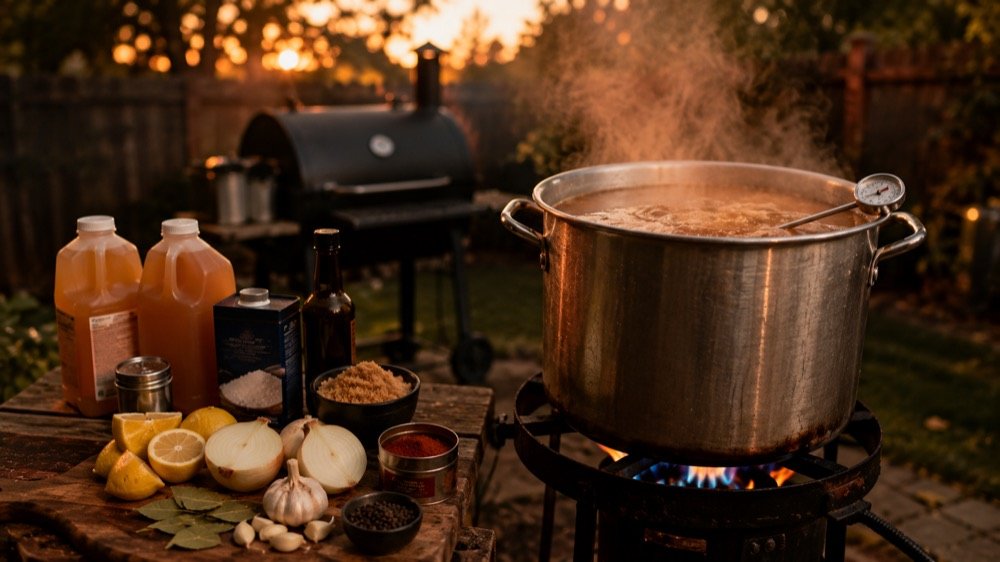

The Pork Butt Brine Starter Guide
The 5½-Gallon Apple Juice Brine for Pulled Pork That's Seasoned Through Every Strand
- Meet your guides: Marcus cooks two or three times a month and wants consistency.
- Dana just bought her first bag of kosher salt.
- Ray is good — and wants to be great. You'll see how each of them runs this brine.
Two Days Early, In a Bucket
Father's Day is coming, and if pulled pork is on the menu, here's the part most backyard cooks never learn: the best pulled pork starts two days early, in a bucket, in the refrigerator — not on the smoker. This guide hands you the exact brine from this week's video, measured out, explained, and made food-safe from pot to pull.
The honest part first, because that's how we do things here. A pork butt does not need a brine the way a lean turkey breast does. It carries enough fat through the muscle that, cooked right, it's hard to dry out — and half the pit community will tell you to skip the bucket entirely. They're not wrong. But here's what the skip-it camp gives up: a brine seasons the whole muscle, so every strand of the pull tastes like something — not just the bark on the outside. And when you're feeding a crowd and holding meat for hours, that seasoning is insurance you'll be glad you bought.
So that's the deal, straight. Weeknight cook? Salt it well and smoke it — no bucket required. Cooking for a yard full of people who matter? Brine it. Everything you need for that second kind of cook is in the next six pages, starting with the recipe itself.
The Brine
This batch makes about 5½ gallons of finished brine — 3.5 gallons of cold water plus 2 gallons of apple juice — which comfortably covers two big bone-in butts with a half gallon left over for the spritz bottle (that trick is in the method). In the video, the cook runs Mott's apple juice; any 100% apple juice works, that's just the house preference. And notice what's missing: apple cider vinegar. The quartered lemon is doing that acid work instead — it reads cleaner and softer in the finished pork.
The Base
| INGREDIENT | AMOUNT | WHY IT'S THERE |
|---|---|---|
| Cold water | 3.5 gallons (14 quarts) | The carrier for everything else |
| Apple juice | 2 gallons | Sweetness and fruit depth — counts in the salt math |
| Kosher salt | 3¾–5 cups (start at ~4) | The engine — seasons the whole muscle |
| Brown sugar | 1⅓–1¾ cups | Rounds the salt, deepens bark color |
| Lemon, quartered | 1 | The acid — stands in for cider vinegar |
The Flavor Boosters
| INGREDIENT | AMOUNT | WHY IT'S THERE |
|---|---|---|
| Worcestershire sauce | ¾–1 cup | Savory depth — the "woo sauce" |
| Garlic cloves, smashed | 8–10 | Whole cloves steep clean, no clouding |
| Onions, quartered | 2 medium | Sweet aromatic backbone |
| Bay leaves | 4–5 | Quiet background herb |
| Whole black peppercorns | 3–4 tbsp | Whole, not ground — flavor without grit |
| Smoked paprika | 3–4 tbsp | The hidden secret — smoke from inside |
| Rosemary and/or thyme | 2–3 tsp dried | Both together is the house move for pork |
Every booster is optional in the sense that the brine still works without it — but together they're what separate this from salty apple water. The one that surprises people is the smoked paprika: it builds a low smoke note into the muscle before the smoker ever sees the meat. Shopping list handled, the next thing standing between you and great pork is the part that ruins the most cooks: the salt.
The Salt Math
When brined pork comes out salty, the recipe almost never failed — the math did. Two mistakes cause nearly all of it. First: salt gets measured against the water instead of the TOTAL liquid. The 2 gallons of apple juice count, which makes this a 5.5-gallon brine, not a 3.5-gallon one. Second: table salt gets swapped in cup-for-cup. It packs nearly twice as dense as kosher, so the same cup quietly doubles the salt. How Dana learned it: her first brine used table salt at the kosher measurement, and the pork ate like ham. Same recipe, right salt, next cook — night and day.
| TOTAL LIQUID | KOSHER SALT — START | KOSHER SALT — MAX |
|---|---|---|
| 1 gallon | ¾ cup | 1 cup |
| 2 gallons | 1½ cups | 2 cups |
| 3 gallons | 2¼ cups | 3 cups |
| 5.5 gallons — this batch | 4 cups | 5 cups |
Start at the low end, always — you can build on a mild brine next cook, but you can't pull salt back out of a butt. For reference, the classic published benchmark is about one cup of kosher salt per gallon, and this recipe sits deliberately inside that band. Stir until salt and sugar are fully dissolved with zero grit on the bottom. Once the math is right, the build order takes over — and yes, the order matters.
The Method, Step by Step
There are steps to this — you don't just dump everything in the pot. The hard ingredients ride the heat up so they dissolve and steep; the acid and the delicate liquids go in after the heat shuts off, so they infuse on the way down instead of cooking away on the way up. That sequencing came from trial and error across thirty-plus years of cooks, and it's the difference between bright, layered flavor and a muddy one-note brine.
- Set the pot — You need 7+ gallons of vessel — a turkey-fry pot on a propane burner is perfect. In go the 3.5 gallons of cold water and about half the apple juice.
- Add the hard ingredients — Kosher salt, brown sugar, smoked paprika, smashed garlic, quartered onions, bay leaves, whole peppercorns, and the herbs. They dissolve and steep as the pot climbs.
- Bring it to a true boil — 212°F, read off a thermometer. Bonus: a rolling boil is a free calibration check — if your gauge doesn't say 212°F in boiling water, now you know its offset for every cook after this one.
- Shut the heat OFF — The moment it hits 212°F, kill the burner. You wanted the boil to happen, not to continue.
- Acid in last, off heat — Stir in the remaining apple juice, the quartered lemon, and the Worcestershire. The citrus steeps while the pot cools — not while it climbs.
- Lid on, walk away — Let it come to room temperature naturally. Don't dump ice in the pot to rush it — the slow steep is doing flavor work the whole way down.
- Verify the temperature — Room temperature or below — about 72°F — checked with a thermometer, never guessed. Warm brine on raw pork starts cooking the surface and parks the whole cut in the danger zone.
- Pull the spritz FIRST — Before any meat touches the liquid, pour off about a half gallon into a clean container and refrigerate it. That's your cook-day spritz — the same flavor that's working inside the meat.
- Bag the butts — Food-grade 5-gallon bags inside a sturdy container or cooler. Two butts fit one bag easily; pour brine over until fully submerged and work the air out.
- Ice bath, then refrigerate — Ice over the bagged meat for the cold shock, then the whole setup goes into the refrigerator at 40°F or below — brine and meat stay cold for the entire soak.
- Brine about 24 hours — That's the window for 10–13 pound butts. Longer is not better — past a point the salt keeps driving and the texture slides toward spongy.
- Out, drain, pat dry, discard — Pull the butts, drain, pat completely dry, and pour the used brine down the drain. It touched raw pork — its job is done.
"This is the brine that is a killer."
The lemons go in last for a reason. In the video Mr. B puts it plainly: he wants the acid in the pot as it's coming down from temp, not while it's climbing — "and that's through trial and error." Acid that boils turns harsh and flat; acid that steeps into a cooling brine stays bright. Thirty years in, it's still one of the quietest upgrades in his whole system.
The next evening, give the butts their second act: pat dry, then a thin coat of yellow mustard as a binder — seasoning sticks to tacky, not slick, the same way nothing sticks to a car in the rain. Season (go easy on the salt; the brine handled the inside), let them sit until the surface turns into a wet paste, wrap, and refrigerate overnight. Cook day, your only job is fire. Before that, though, lock in the rules that make the whole soak safe.
The Cold Chain
Everything else in this guide is preference. This section is not. A brine holds raw pork in liquid for a full day, which makes temperature control the whole game. The USDA danger zone runs 40–140°F, and bacteria in that range can double every 20 minutes. These are the lines, straight from the federal food-safety standards:
| CHECKPOINT | THE NUMBER | WHY IT MATTERS |
|---|---|---|
| Brine before meat goes in | ~72°F or below, verified | Warm brine cooks the surface and enters the danger zone |
| Brine + meat during the soak | 40°F or below, all 24 hrs | USDA cold-holding line for raw meat |
| Used brine after the soak | Discard — every time | Touched raw pork: never reuse, never baste, never save |
| Whole-muscle pork, safety | 145°F + 3-minute rest | USDA minimum safe internal temperature |
| Pulled pork, texture | 195–205°F, probe-tender | Collagen needs the extra heat — texture, not safety |
| Leftovers | Fridge within 2 hrs; reheat 165°F | USDA leftover handling — 1 hour if it's over 90°F out |
Yes, and if your refrigerator can't swallow a 5-gallon setup — run the cold chain in a cooler instead. Bag the butts with the brine, surround them with ice, close the lid, and check with a thermometer every few hours, topping up ice to hold 40°F or below. Same rules, different box. What you never do is let the soak sit at room temperature and hope.
One more rule worth repeating because it protects the best trick in this guide: spritz liquid comes out of the pot BEFORE the meat goes in — never after. With the system down, here are the five mistakes that catch almost every first-time briner.
Five Mistakes That Ruin a Brined Butt
Every one of these comes from a real cook — and every one has a ten-second fix.
- Swapping in table salt. It happens because the boxes sit side by side and look interchangeable. They aren't — table salt packs nearly double the salt into the same cup. The fix: kosher salt, full stop. If table salt is truly all you have, cut the volume roughly in half — but kosher is worth the trip.
- Salting the water, not the liquid. It happens because the recipe starts with 3.5 gallons of water and people salt for 3.5 — forgetting the 2 gallons of apple juice. The fix: salt for the TOTAL, 5.5 gallons in this batch, starting at the low end of the table.
- Rushing the cool-down. It happens because a hot pot is boring to wait on. But warm brine starts cooking the meat's surface and drags the whole cut into the danger zone. The fix: lid on, walk away, and verify room temperature with a thermometer before the pork goes anywhere near the pot.
- Brining too long. It happens because "more time, more flavor" feels logical. It isn't. Past about 24 hours the salt keeps driving and the texture slides toward spongy ham. The fix: 24 hours for big butts — then out, dried, and seasoned.
- Saving used brine. It happens because the brine smells too good to pour out. The fix: pull your spritz portion before the meat ever goes in, and send the rest down the drain after the soak. Brine that touched raw pork never works a second job.
The Brine-Day Checklist

Print this page and tape it up. Two days before you serve, work top to bottom — when every box is checked, the hard part of your cook is already done. How Marcus runs it: he checks the first four boxes in the kitchen before the pot ever lights, so the build never stalls halfway with a missing ingredient.
- 7+ gallon pot and burner staged — outdoors or well-ventilated (Afternoon)
- 3.5 gal cold water + 2 gal apple juice on hand (Afternoon)
- Kosher salt (not table) — 4 cups measured out (Afternoon)
- Brown sugar, lemon, and all seven boosters laid out (Afternoon)
- Hard ingredients in while the pot climbs; stirred to zero grit (Evening)
- 212°F verified at the boil — heat OFF immediately (Evening)
- Remaining juice, lemon, Worcestershire in AFTER heat off (Evening)
- Lid on; cooled naturally to ~72°F — thermometer-verified (Late evening)
- Spritz portion (~½ gallon) pulled FIRST and refrigerated (Before meat)
- Butts bagged, fully submerged, air worked out (Night)
- Ice bath on top; everything into the fridge at 40°F or below (Night)
- Timer set: ~24 hours to the pat-dry and season (Night)
- Used brine down the drain after the soak — no exceptions (Next night)
From Brined to Legendary
That's the system: measure against total liquid, build in order, acid last, cool it honest, spritz pulled first, and keep the cold chain unbroken. Run it once and it stops being a recipe and starts being the way you cook. Ray ran the video's taste-test challenge — one shoulder cut in four, each piece brined differently, smoked together — and this brine took first at his table. Try the same test; let your own crowd vote.
Checklist — Completed
- Salted for the TOTAL liquid with kosher salt
- Built the brine in order — acid in last, off heat
- Verified room temp with a thermometer before the meat went in
- Pulled the spritz portion first
- Held the soak at 40°F or below for ~24 hours
- Discarded the used brine
You Now Have In Hand
- The complete 5½-gallon apple juice brine, base and boosters
- Salt math that scales to any batch size without salty pork
- A 12-step build with the why behind every step
- The USDA cold-chain numbers that keep a 24-hour soak safe
- A printable brine-day checklist, ready for Father's Day weekend
What's Next
This guide gets your pork into the smoker seasoned through every strand — and if you stop here, your Father's Day table is already in good shape. The Pulled Pork Pitmaster Playbook goes the rest of the way: the full smoke-day method step by step, scaling formulas for any number of butts, flavor variations on this base brine, a troubleshooting section for when the cook fights back, and printable pit logs to run the whole day from one clipboard. It's built like a manual and priced like a sandwich. Get it at www.backyardbbqr.com
Backyard BBQ-R — real backyard cooking, taught straight.
www.backyardbbqr.com • youtube.com/@BackyardBbqR • backyardbbqr@gmail.com
Run it yourself and let Mr. B know how it goes.