An after-work roast can outlast the evening you planned for it. Part 2 follows a bottom round from the red kamado into the kitchen, but changing heat sources is only one decision. The useful question is what the roast needs next: more cooking, service, a monitored hold, or prompt refrigeration. Keep this card beside the cook, not beside a promised finish time.
Choose the Next Step
Check the roast and choose the row that matches its condition; these are decisions, not a fixed-time recipe.
| What You Know | Next Step |
|---|---|
| Time elapsed | Verify temperature and tenderness rather than declaring the roast done by elapsed time. |
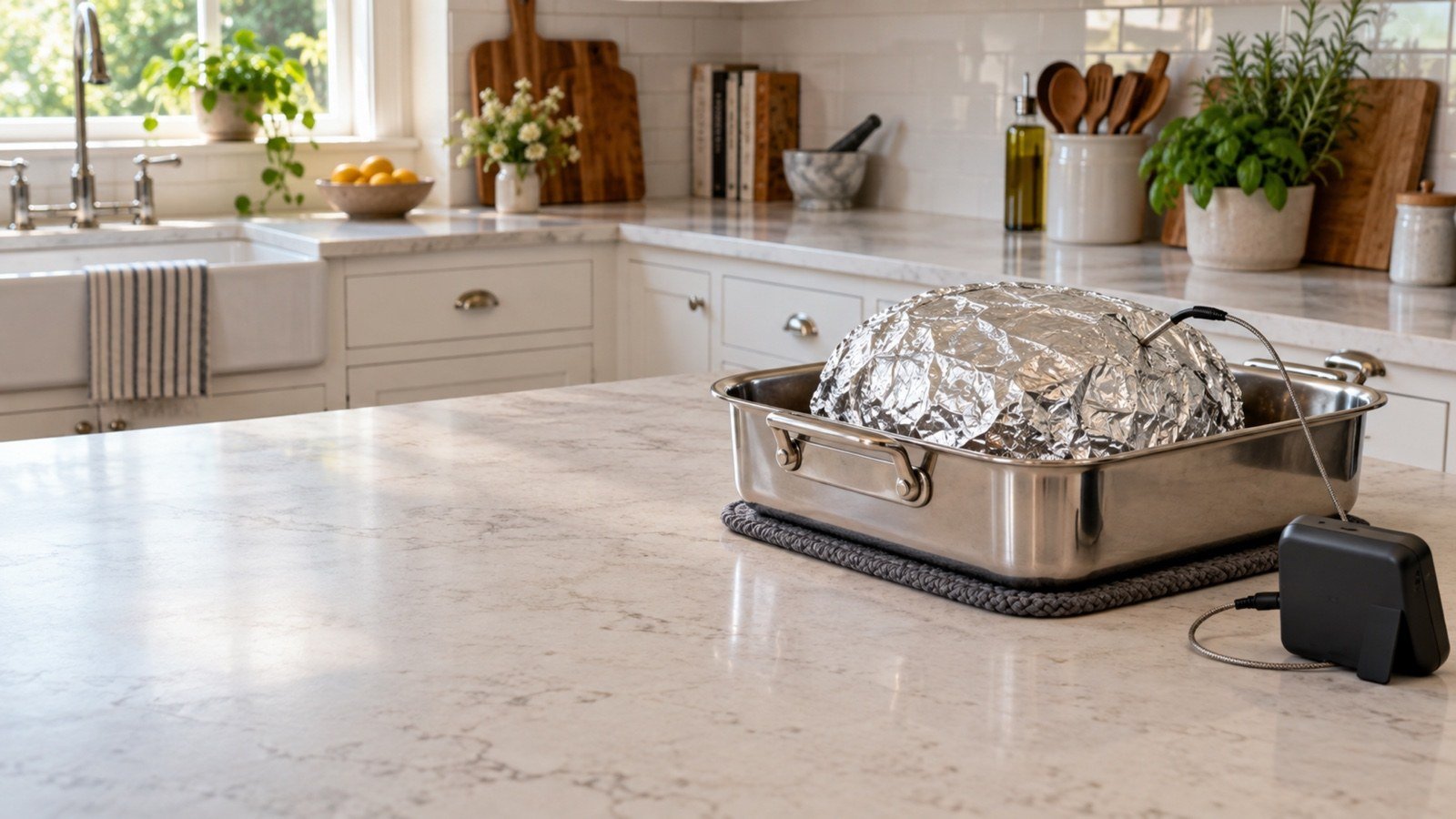
| Changing heat sources | Transfer immediately to the preheated oven and continue cooking without a refrigeration break. |
| Texture still resists | Continue cooking and reassess texture; the safe minimum is not a promise of pot-roast tenderness. |
| Dinner is soon | Serve, or verify the meat remains at or above 140°F throughout a hot hold. |
| Another meal | If saving for later, divide the cooked roast and juices into shallow containers and refrigerate promptly, within 2 hours, or 1 hour above 90°F. |
For the written conventional-oven method, follow USDA consumer guidance to set the oven at 325°F or above and monitor the food with a thermometer. That is a corrected teaching method, not a claim about the final setting in the episode.
Straight from the grill to the oven.Mr. B, from Part 2
What They Don’t Tell You
Three details keep the handoff from becoming a guess.
- A dark surface does not tell you the center temperature or prove a safe hold.
- Do not use 160°F as a universal smoke-flavor cutoff. Choose wrapping based on the surface and cooking plan; the stall is not a smoke-off switch.
- Do not use a switched-off oven as an unmonitored holding or cooling method.
I want the oven to change where the cook happens, not whether I’m paying attention.
Whole beef roasts: 145°F with at least a 3-minute rest.
Verify the meat remains at or above 140°F throughout a hot hold.
Refrigerate cooked portions and juices promptly in shallow containers.
Use refrigerated leftovers within 3–4 days and reheat to 165°F.
Choose the storage path before opening the foil so the next step is ready.
Three Mistakes
These errors are easier to prevent than rescue.
- Cooking to the clock: use the clock for check-ins, then verify temperature and tenderness.
- Confusing warmth with a hold: measure the meat instead of trusting a warm oven cavity.
- Leaving tomorrow’s roast whole on the counter: prepare shallow containers before the cook ends.
A short final check keeps those fixes practical.
Before You Go
Use these seven checks before leaving the cooking station.
The finished roast needs a handling plan just as much as it needed a cooking plan.
The Pot Roast Finish Playbook
The Pot Roast Finish Playbook expands this after-work decision into a monitored handoff, a troubleshooting system, and three cook-day tools. Watch Part 2 to follow the source cook, then use the written safety corrections when planning your own finish.
Get the Pot Roast Finish Playbook →Watch Part 2
Mr. B
Cooking backyard BBQ since 1996. Practical backyard cooking, with written safety guidance kept distinct from the recorded cook.
— Mr. B, Backyard BBQ-R